Since 2020, our team focussing on eXtended Reality (XR) at Deloitte Digital Belgium has been exploring the edges of immersive technology: experimenting, prototyping, and learning our way through a rapidly evolving landscape. With approximately 20% of our time dedicated to Research & Development, we’ve built a rich body of work that spans both client-driven projects and internal Proofs of Concept (PoC), reflecting not only technological progress but also the team’s growing intuition about what meaningful, human-centered XR can be.
This article is part of a chronological series that retraces the hidden side of that R&D journey: each article highlights one POC: the context in which it was created, the technology choices behind it, the challenges we faced, and the insights that shaped our next steps. Together, these stories reveal how experimentation fuels capability building.
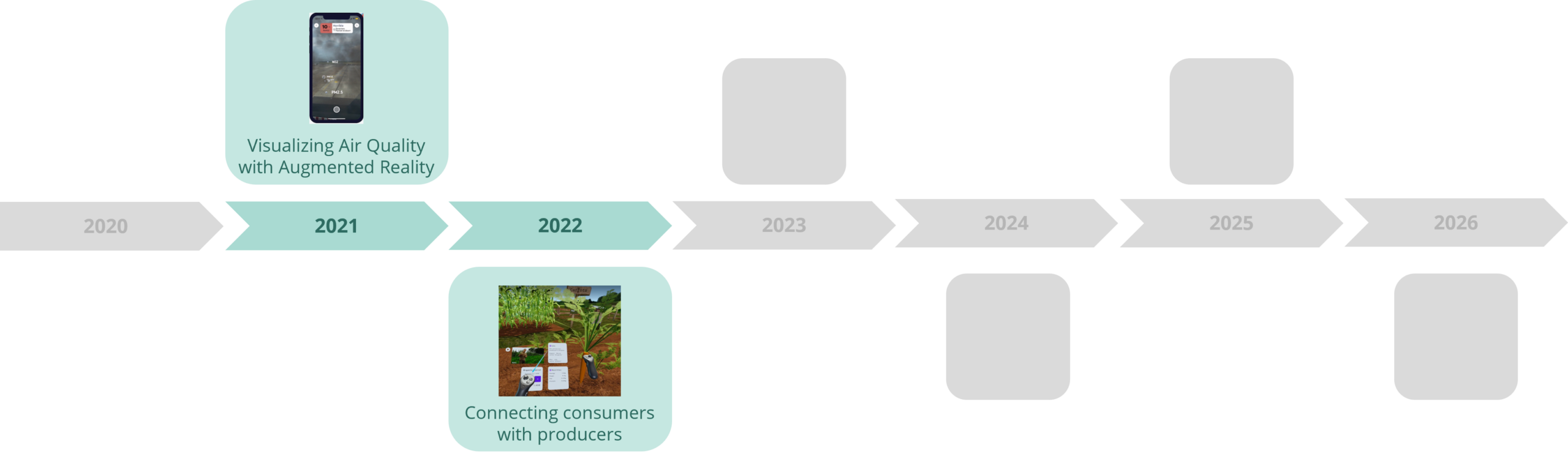
Next projects to be revealed soon…
The project: What if we took customers to the farm?
In 2022, we had a straightforward problem: a retailer wanted to strengthen its brand by showing customers where their food came from. How do you tell a story about ethical, sustainable farming in a way people actually remember?
The obvious answer was a marketing campaign. But we asked something different: what if we transported people directly to the farm?
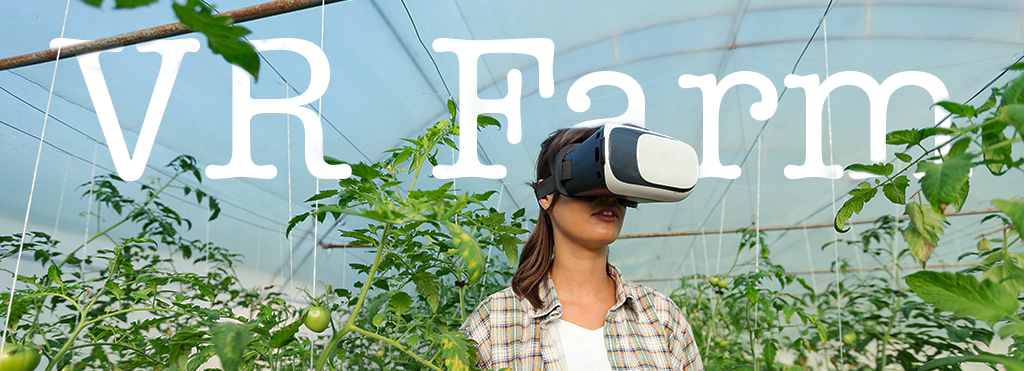
That became the Virtual Vegetable & Fruit Farm. An immersive VR experience where users could walk through a virtual organic farm, pick up vegetables and fruits (like carrots and apples), and see where they came from. Origin, growing season, nutrition, price. Wind blowing. Bird sounds. The whole thing was designed to feel intimate and local, not industrial.
The project had two purposes. One was to understand how consumers react to this new way to shop. The other was to learn, as we were mostly used to develop on enterprise hardware like Hololens. So this was one of our first projects on consumer hardware, specifically the Meta Quest 2. We needed to understand how designs actually work when you put them on someone’s head.
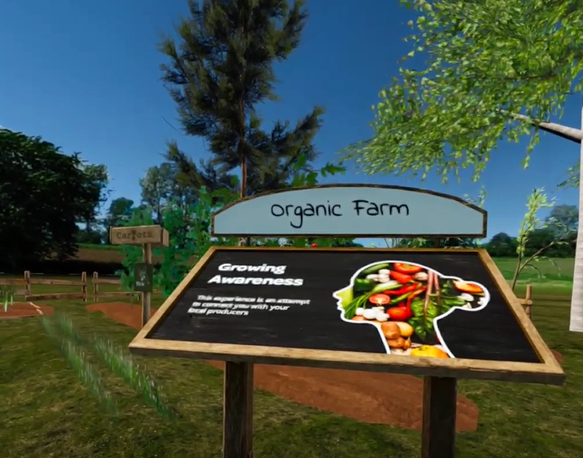
The hardware constraints
The Quest 2 wasn’t very powerful. Early on, we tried building expansive carrot fields, maybe 100 meters square. The idea was to create a sense of scale and space.
It didn’t work. The hardware couldn’t do both detail and scale. We had to pick one.
We picked intimacy. A smaller farm, higher quality, that actually fit the story we wanted to tell. What looked like a limitation became the right design choice.
The interaction design problem we had to solve
In 2022, VR interaction wasn’t very standardized yet. How do you navigate? How do you pick things up? We had to figure it out through testing.
User testing showed us something we didn’t expect: people ignored written instructions in VR.
So we changed the approach. Instead of telling people what to do, we showed them. Users started outside the farm. Their first action was teleporting in. That single moment taught them how to navigate. No text needed.
It worked. People understood the controls without reading anything.
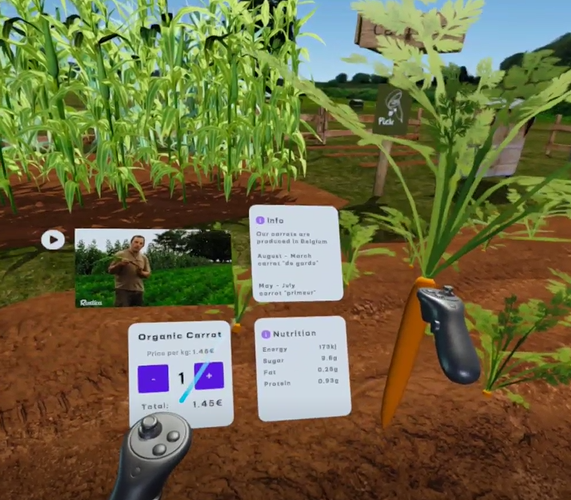
The details that made it feel real
With testing, we got the confirmation that immersion comes from small things. Wind effects. Spatial audio. Bird sounds. These weren’t nice extras. They were essential to immerse users.
But there was a tension we kept running into: a lot of our development time went into optimization. Making the experience run on the Quest 2. Not into making it better or richer, just into making it work at all.
We spent a lot of time optimizing things that didn’t improve the actual experience. They just made it technically possible. Looking back, that’s something would be different now.
How we’d build it today
If we built this now, it would be completely different.
Modern headsets can handle about 20 times more content than the Quest 2. We would spend less time optimizing and more time making the farm beautiful. More plants. Better wind effects. More detail everywhere.
We did experiment with desktop-connected versions later. Those could do things the Quest 2 never could, for instance, wind blowing individual plants realistically. But they lost something: portability. You couldn’t put them in a supermarket or a temporary installation. There’s always a trade-off.
What this taught us
The lessons from this project stuck with us. How to onboard people into VR without overwhelming them. How to use environmental detail to create immersion. How to think about optimization and experience quality.
This project forced us to grapple with real hardware constraints. To question what we thought we knew about interaction design. To discover that immersion comes from thoughtful detail, not technical spectacle.
It also validated something important: VR can tell meaningful stories. About where food comes from. About sustainability. About local production.
Clyde Pashley
Lead 3D modeling & Unity development