In our previous article, we focused on professionals whose companies have already invested in XR technologies, exploring both the motivations behind adoption and the ROI they perceived from these initiatives. However, the survey also revealed that a large majority of respondents work in companies that have not yet implemented XR. In this third article, we explore how Belgian professionals perceive XR technologies, providing further insight into the factors that may currently be limiting adoption.
In this article, we broaden the perspective by looking at the views of all respondents, both XR users and non-users. Rather than examining actual implementation outcomes, this article focuses on perceptions: the benefits professionals believe XR could bring to their organizations, the barriers they associate with adoption, and their expectations regarding future implementation.
Links to our previous articles: Exploring XR demand in Belgium: Introduction to our new series & XR adoption in Belgium
How Belgian professionals believe XR could benefit companies
The survey results show that Belgian professionals mainly associate XR with practical business value rather than experimentation. The most commonly perceived benefit was the improvement of employee training, followed by enhanced customer experience and the optimization of operational processes. In contrast, cost reduction was mentioned the least, suggesting that XR is currently viewed more as a tool for improving performance and innovation than purely reducing expenses.
These perceptions align with recent international trends observed in 2025 and 2026. Across industries, XR adoption is increasingly driven by immersive training and operational efficiency use cases. Recent studies and industry reports have highlighted how XR can accelerate onboarding, improve knowledge retention and support more efficient workflows. At the same time, companies are also exploring XR to create more engaging customer experiences and strengthen collaboration between teams. Overall, Belgian professionals appear to share a vision of XR that is closely aligned with the current direction of the global market.
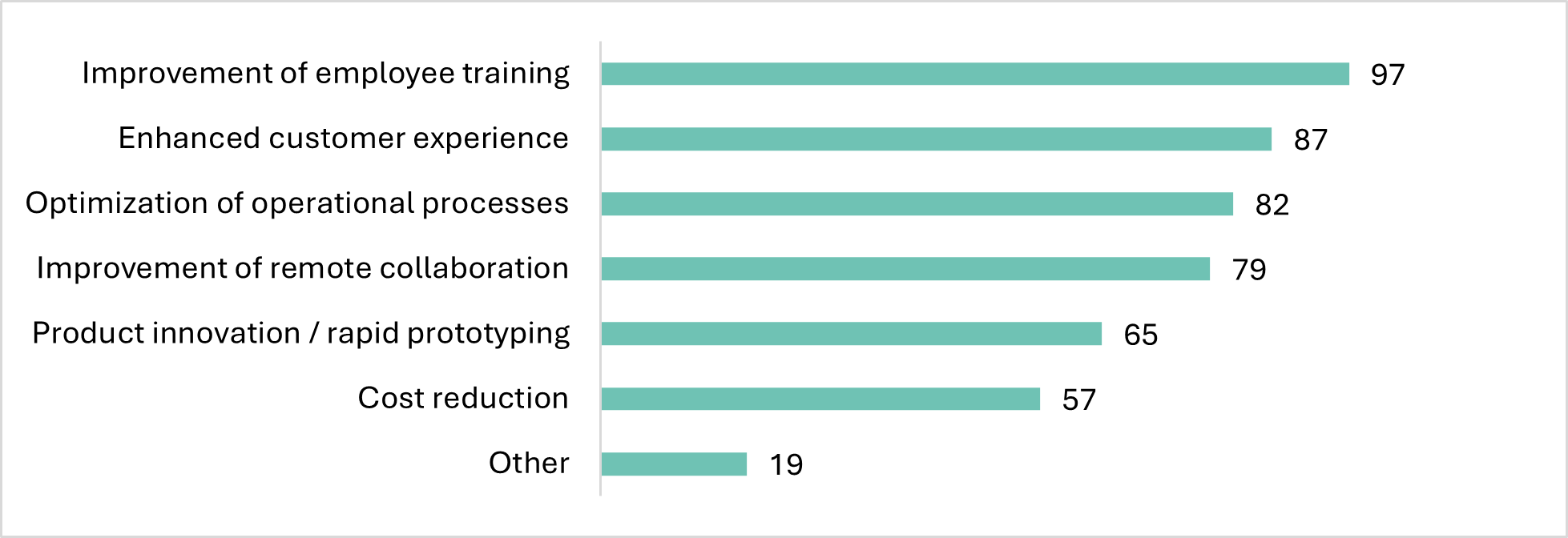
What do you think are the main benefits that extended reality (XR) could bring to your company?
The main concerns surrounding XR adoption
Belgian professionals see clear opportunities in XR, but these perceived benefits alone have not been enough to drive widespread adoption. To understand why, respondents were asked to identify the key barriers they believe are limiting broader deployment in companies today.
The most dominant obstacle identified by Belgian professionals is the high cost of equipment and solutions, mentioned by 144 respondents. This aligns closely with recent industry reports highlighting cost as one of the primary frictions in enterprise XR deployment, particularly due to hardware investment, content development, and scaling expenses
Beyond cost, the lack of internal skills and expertise emerges as the second major barrier (82 responses). This reflects a broader trend observed in recent XR studies, where the shortage of implementation know-how is repeatedly cited as a key bottleneck to scaling beyond pilot projects. In other words, even when interest exists, many organizations simply lack the internal capabilities to move from experimentation to full deployment.
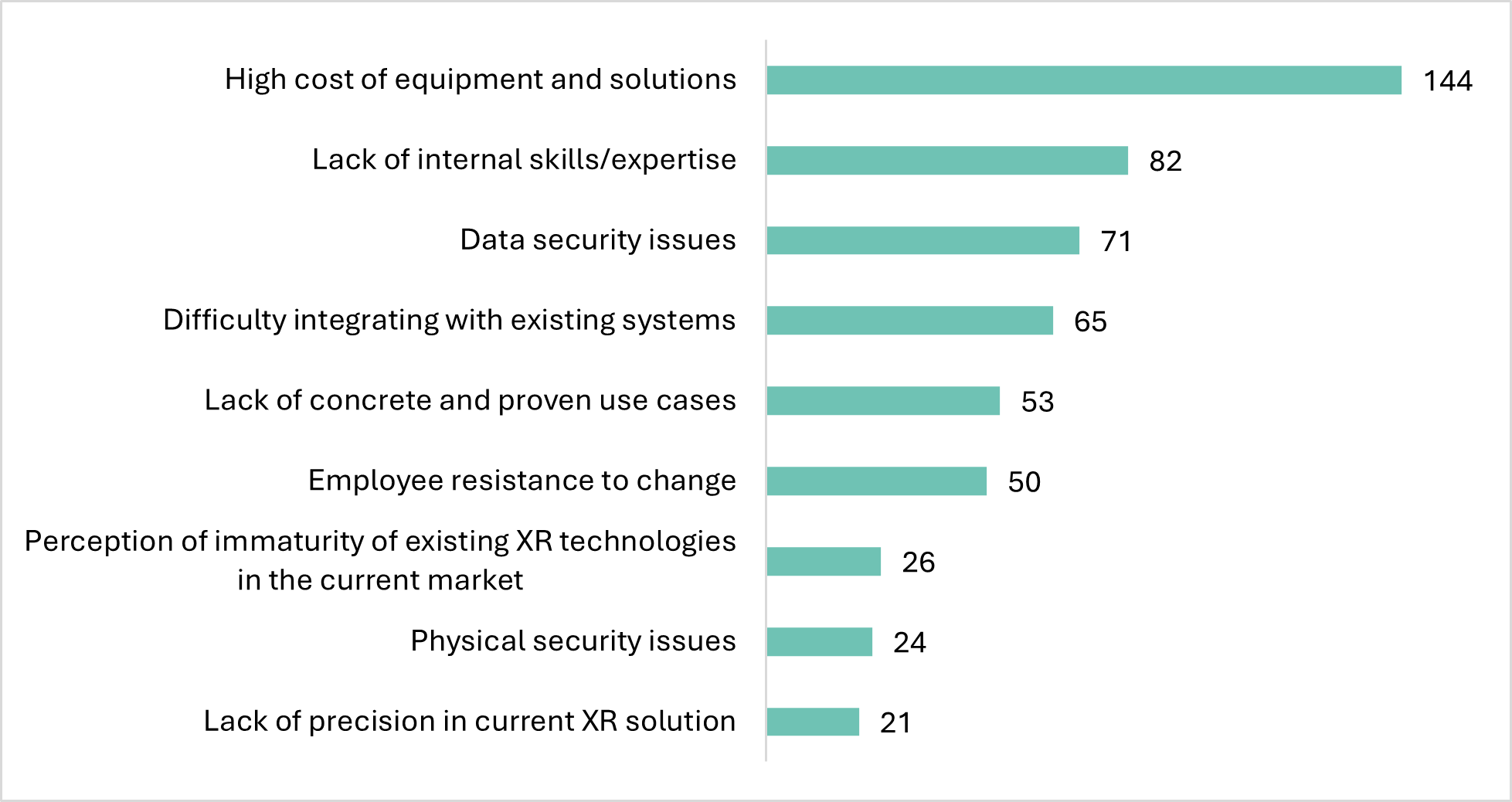
What do you think are the main obstacles to the adoption or wider deployment of extended reality (XR) in your organisation?
Expected adoption timeline
To better understand how XR may evolve within organizations, respondents were asked to estimate the time horizon within which they expect to integrate an XR solution into their professional activities or significantly expand its use. The results reveal a highly divided outlook, ranging from short-term implementation plans to a significant share of respondents who do not foresee adoption at all.
First of all, what stands out is that the largest single group in the distribution is the 96 respondents (representing roughly a third of the respondents) who believe XR will never be implemented in their organization. This highlights a substantial level of resistance or perceived irrelevance of the technology.
For respondents who do foresee XR being integrated into their professional activities, the most common timeframe is three to five years (80 responses), indicating that many professionals still view XR as a medium-term development rather than an immediate priority. This is followed by six to ten years (37) and more than ten years (35). In contrast, fewer respondents expect short-term adoption, with 40 anticipating integration within one to two years and only 12 within the next year. Overall, the results suggest a cautious outlook, with XR largely perceived as a medium- to long-term prospect rather than an imminent shift, alongside a substantial group that does not foresee adoption at all.
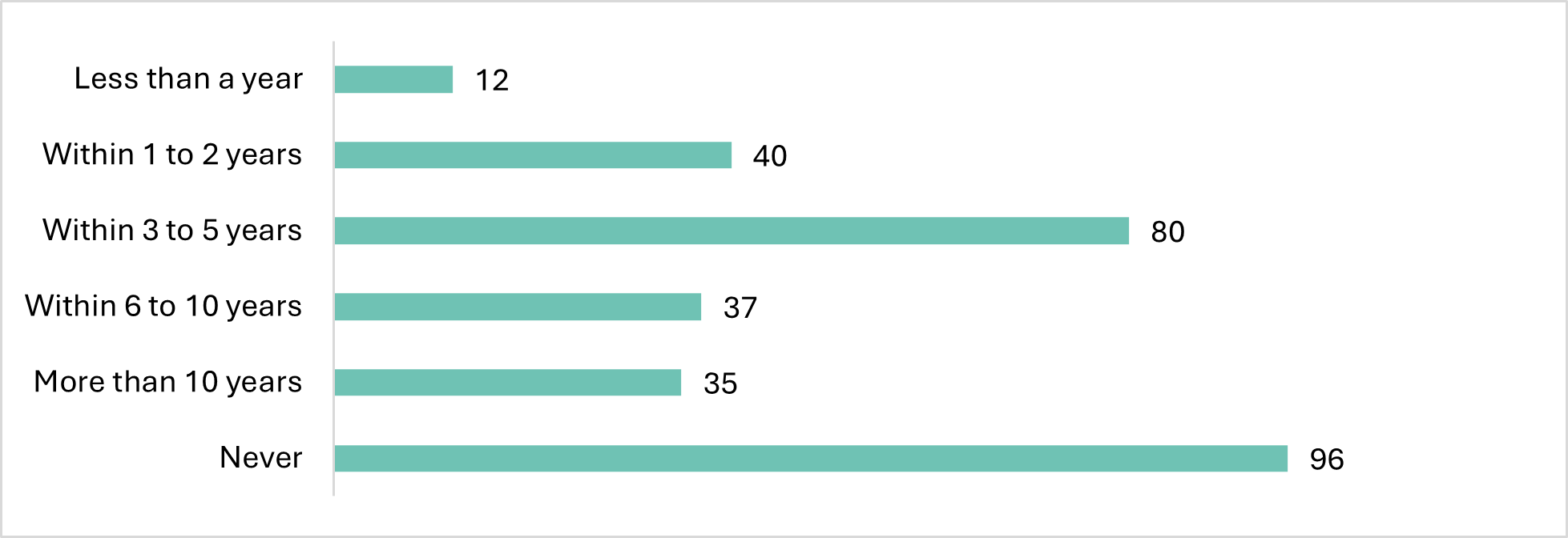
Within what timeframe do you plan to integrate an XR solution into your professional activity, or to significantly expand its use?
Where XR is expected to make an impact
Respondents were invited to share their opinions on the potential future applications of XR technologies, revealing several key application areas. The most frequently mentioned was training and learning, with many references to technical, practical and behavioral training conducted both in-person and remotely. VR and AR were highlighted as tools to make these training sessions more immersive and effective. Visualization, simulation and presentation also featured prominently, including the visualization of interventions, products and locations, as well as the simulation of processes and customer experiences. Additionally, respondents saw significant potential in enhancing meetings and presentations through immersive technologies. Improving customer experience and marketing was another important area, with applications such as virtual sales, digital marketing, customer loyalty programs and virtual assistance considered promising uses of XR.
Conclusion
In conclusion, Belgian professionals demonstrate clear recognition of XR technologies’ potential to transform employee training, enhance customer experiences, and drive operational efficiency. Yet adoption remains constrained by two critical barriers: perceived high implementation costs and insufficient internal expertise. Our client discussions reveal a deeper root cause: the absence of compelling, widely-shared success stories across industries limits visibility into XR’s true value proposition. This knowledge gap perpetuates the paradox of high perceived costs without corresponding awareness of potential ROI—a perception that can only shift through demonstrated business outcomes.
To address this challenge, we’ve developed a survey designed to help companies understand where they stand compared to their peers, what ROI they can realistically expect based on industry benchmarks, and which inspiring use cases are most relevant to their context.
If you’d like to receive a personalized results report for your organization, you’re welcome to take the survey. It’s free, and your results will be delivered by email starting in Q4 2026.
XR Maturity Framework for company

Lilli Bouché
XR Experience Designer