In our first article, we introduced the XR demand landscape in Belgium and outlined the scope of the survey we conducted. (If you haven’t read it here is the link). Now, this second article dives into the adoption landscape, the motivations driving XR investments, and most importantly, what the ROI data tells us about which companies are winning with XR and which are struggling to justify their investments.
Current XR Adoption
The data paints a clear picture: XR adoption in Belgium remains selective, not mainstream. More than half of surveyed companies do not currently use any XR technology. This significant gap between adopters and non-adopters raises an important question: what prevents the majority of organizations from embracing these technologies? The barriers to adoption, ranging from cost concerns to technical challenges and organizational readiness, will be the focus of our next article, where we will explore the obstacles that keep companies from taking the XR leap.
Among those organizations that have adopted XR, Virtual Reality leads the way with 11% adoption. This is followed by Mixed Reality, Augmented Reality and Digital Twins/Metaverse, each claiming approximately 5% adoption. What this tells us is that XR is still in the early-to-mid adoption phase in Belgium.
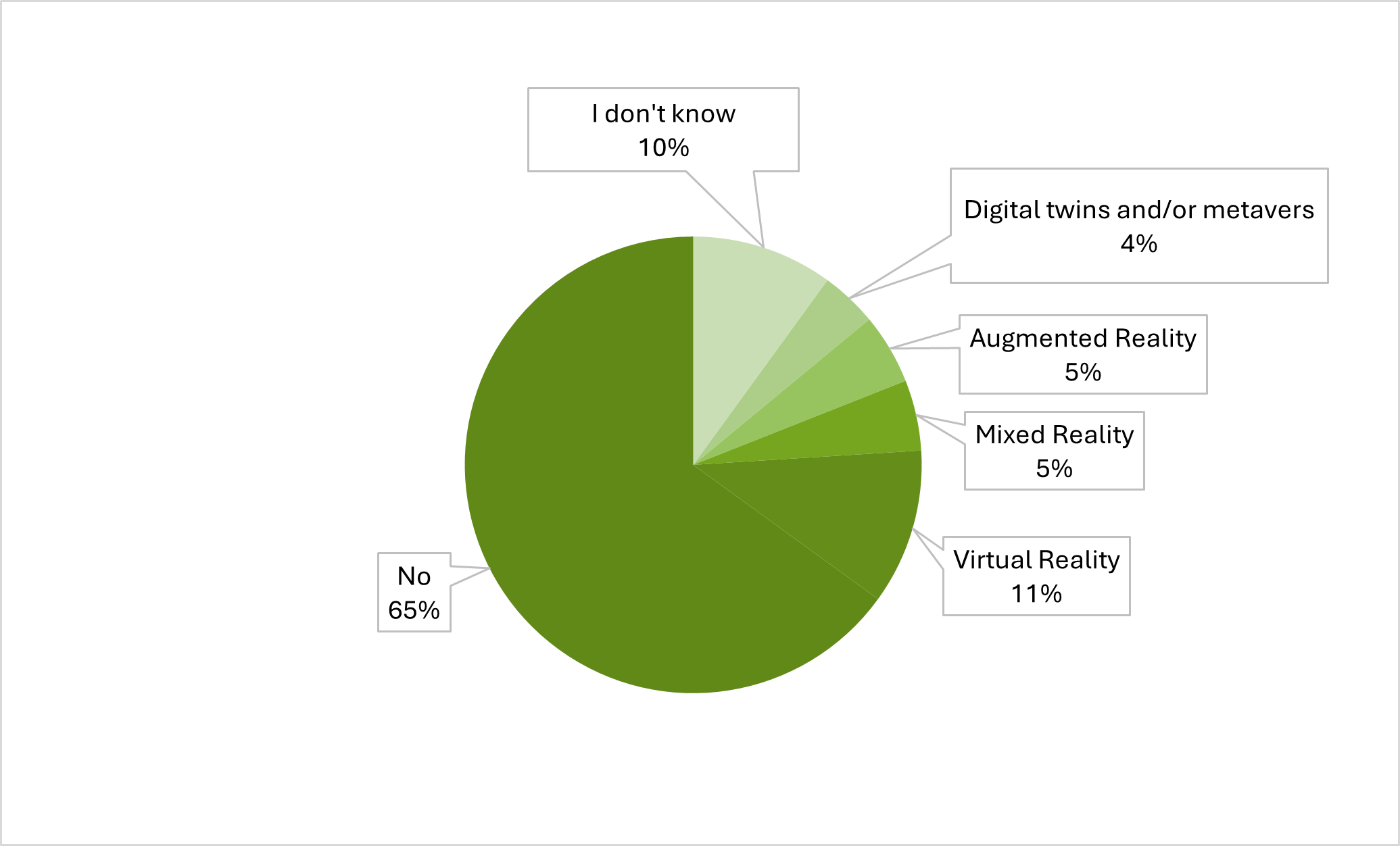
“Does your company currently use XR solutions ?”
Why companies invest in XR : the motivations
Among the organizations that have embraced XR, the two main motivations for its adoption are the exploration of new technologies and their potential applications and addressing specific training and educational needs.
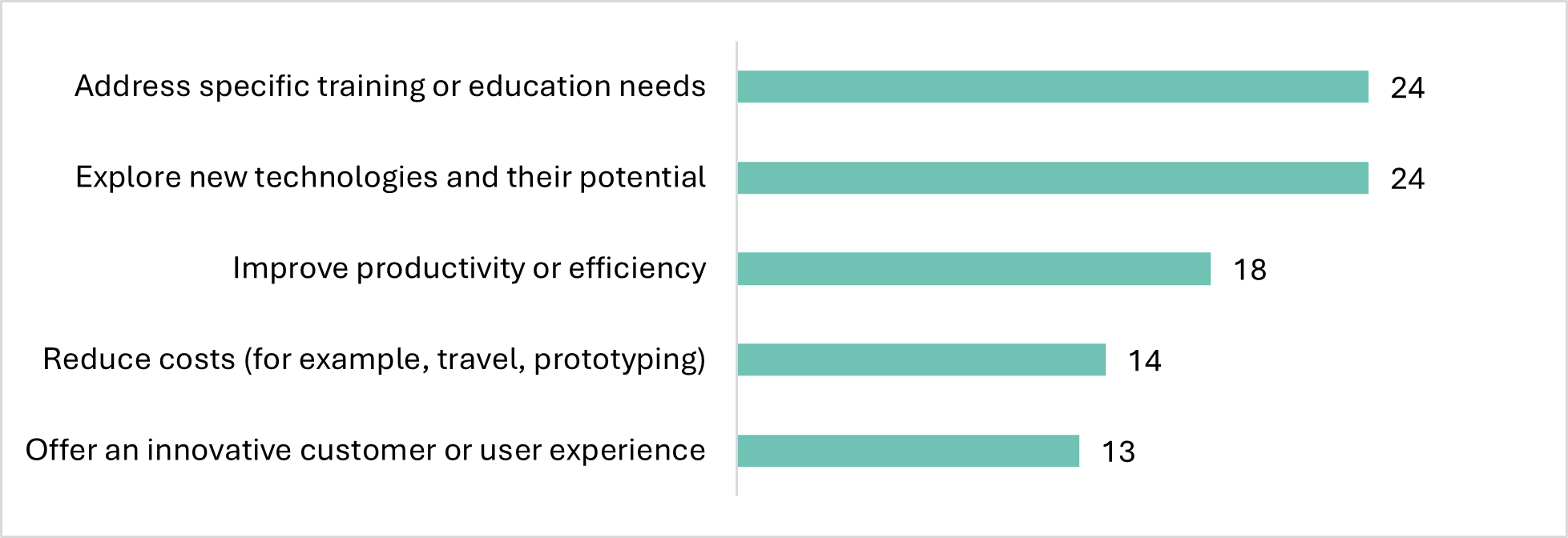
Main reasons for XR adoption
The ROI question: Are XR investements paying off?
When asked about the return on investment (ROI) from implementing XR technologies, responses indicate a generally positive outlook, although with some uncertainty. A total of 22 (34%) respondents reported a positive or very positive ROI, suggesting that many companies have experienced tangible benefits from their XR initiatives. However, 16 respondents described the ROI as mitigated, reflecting mixed or moderate results. A smaller number reported negative outcomes, with 3 indicating a negative ROI and 1 a very negative ROI (6% combined). Notably, 16 respondents (25%) were unsure of the ROI, and 6 (9%) indicated that the ROI has not yet been measured, highlighting that for a significant portion of companies, the impact of XR investments remains unclear or unquantified at this stage.
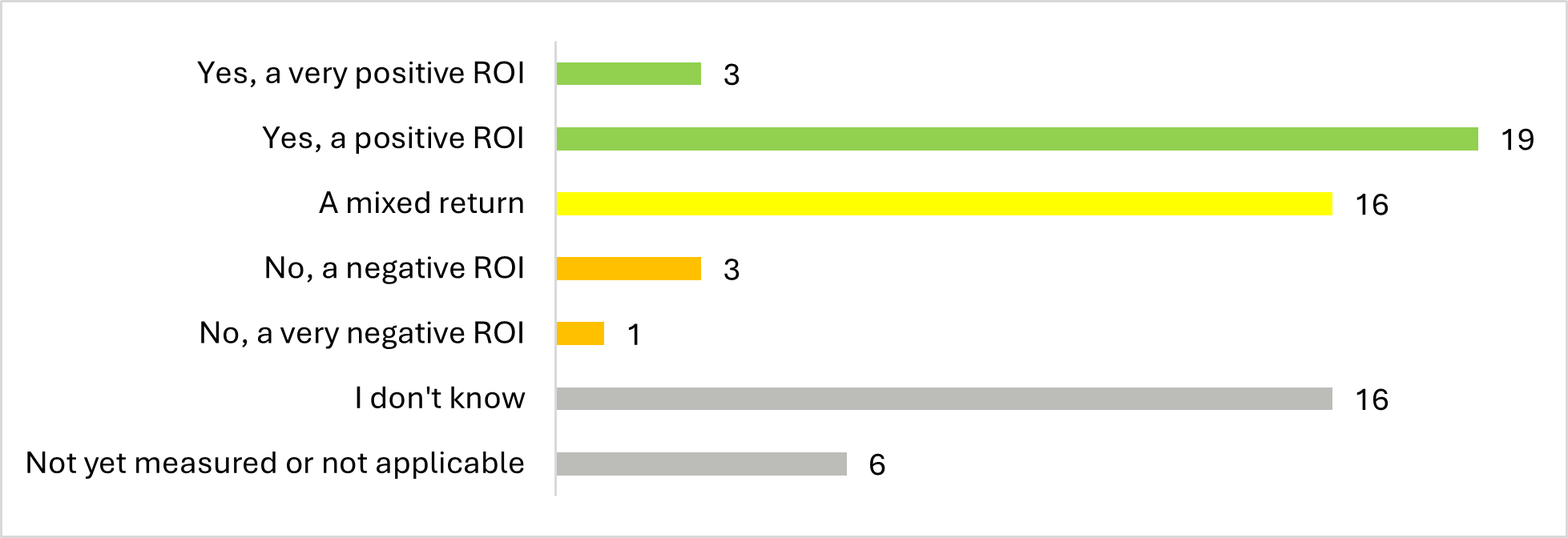
ROI from XR adoption
Why some companies struggle
Despite the predominantly positive ROI outcomes, some companies have experienced negative returns on their XR investments. Let’s examine the reasons behind these results.
Cost misalignment emerges as the primary issue. Initial investments often prove disproportionately high relative to results, with hidden costs (maintenance, updates, training staff) frequently exceeding expectations. Technology-industry mismatch represents a second challenge, where generic XR platforms don’t adequately address industry-specific needs, forcing expensive customization. Finally, measurement gaps plague many implementations, companies lacking clear KPIs and success metrics from the start cannot track whether investments are paying off, creating a cycle where poor measurement prevents optimization.
34% indicate a positive ROI, what’s driving it ?
Companies experiencing positive returns from XR investments cite several key benefits. Training excellence stands out, with organizations reporting enhanced understanding and knowledge retention through immersive, realistic simulations that accelerate learning and reduce time-to-competency for complex skills.
Then, cost reductions, with companies realizing lower training and HR expenses, reduced operational costs through optimized workflows, and fewer errors due to better preparation. Operational gains, improved workflow efficiency, more precise task execution, and enhanced safety, create a multiplier effect that compounds over time.
Finally, companies gain competitive advantages through market differentiation, improved talent attraction through innovative training programs, and first-mover advantage in XR-enabled processes.
What’s next to come ?
Our next and third article will broaden the perspective by examining the perceptions of all respondents, both XR users and non-users, on the future of XR. We’ll explore the barriers they perceive, the benefits they envision, their expectations for adoption timelines, …
Link to the third article : What Belgian professionals think about XR

Lilli Bouché
XR Experience Designer