Since 2020, our team focusing on eXtended Reality (XR) at Deloitte Digital Belgium has been exploring the edges of immersive technology: experimenting, prototyping, and learning our way through a rapidly evolving landscape. With approximately 20% of our time dedicated to Research & Development, we’ve built a rich body of work that spans both client-driven projects and internal Proofs of Concept (PoC), reflecting not only technological progress but also the team’s growing intuition about what meaningful, human-centered XR can be.
This article is part of a chronological series that retraces the hidden side of that R&D journey: each article highlights one POC: the context in which it was created, the technology choices behind it, the challenges we faced, and the insights that shaped our next steps. Together, these stories reveal how experimentation fuels capability building.
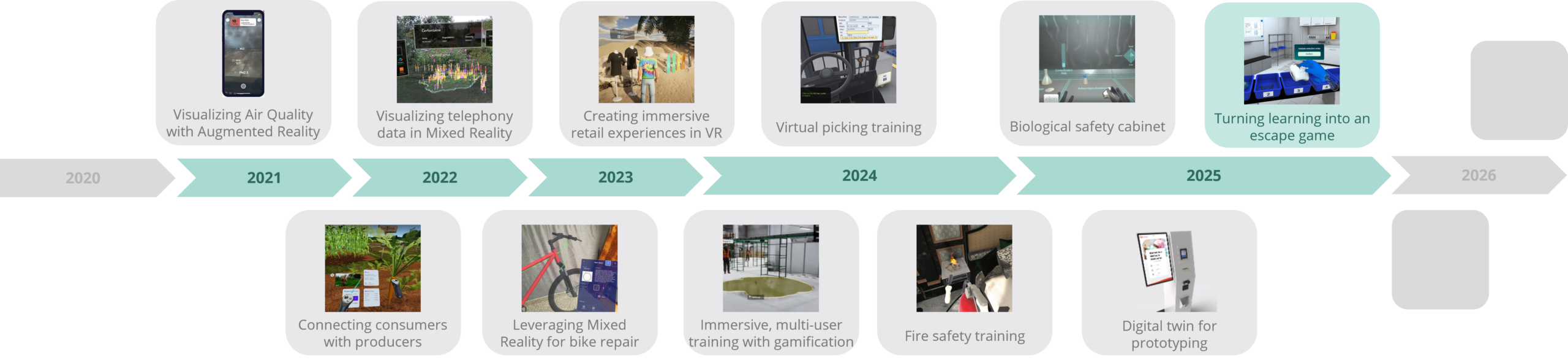
Next projects to be revealed soon…
Why traditional training fails
Imagine a group of workers sitting through a two-hour PowerPoint presentation on Good Manufacturing Practices (GMP). They might take notes. Some might even look engaged. But here’s what research tells us: within hours of closing that presentation, they’ll forget most of what they learned.
This was the challenge our partner, Ikoris, brought to us in 2025. Their clients, pharmaceutical companies with high-risk laboratory environments, faced a critical gap. Traditional training (PowerPoint, videos, online modules) didn’t stick. Trainees would skim materials, answer easy questions at the end, and arrive at the physical laboratory still unprepared. A facilitator then had to spend weeks guiding them through each procedure, before they could work independently.
The stakes were high. In a pharmaceutical laboratory, a single mistake, a missed safety step, a contaminated procedure, or a protocol violation can have serious consequences. Beyond the risks to health and safety, it can compromise product integrity, halt production for days, lead to entire batches being discarded, and delay research efforts by forcing teams to repeat weeks of work.
We needed a different approach entirely.
An escape room for safety training
What if we made safety training emotionally engaging?
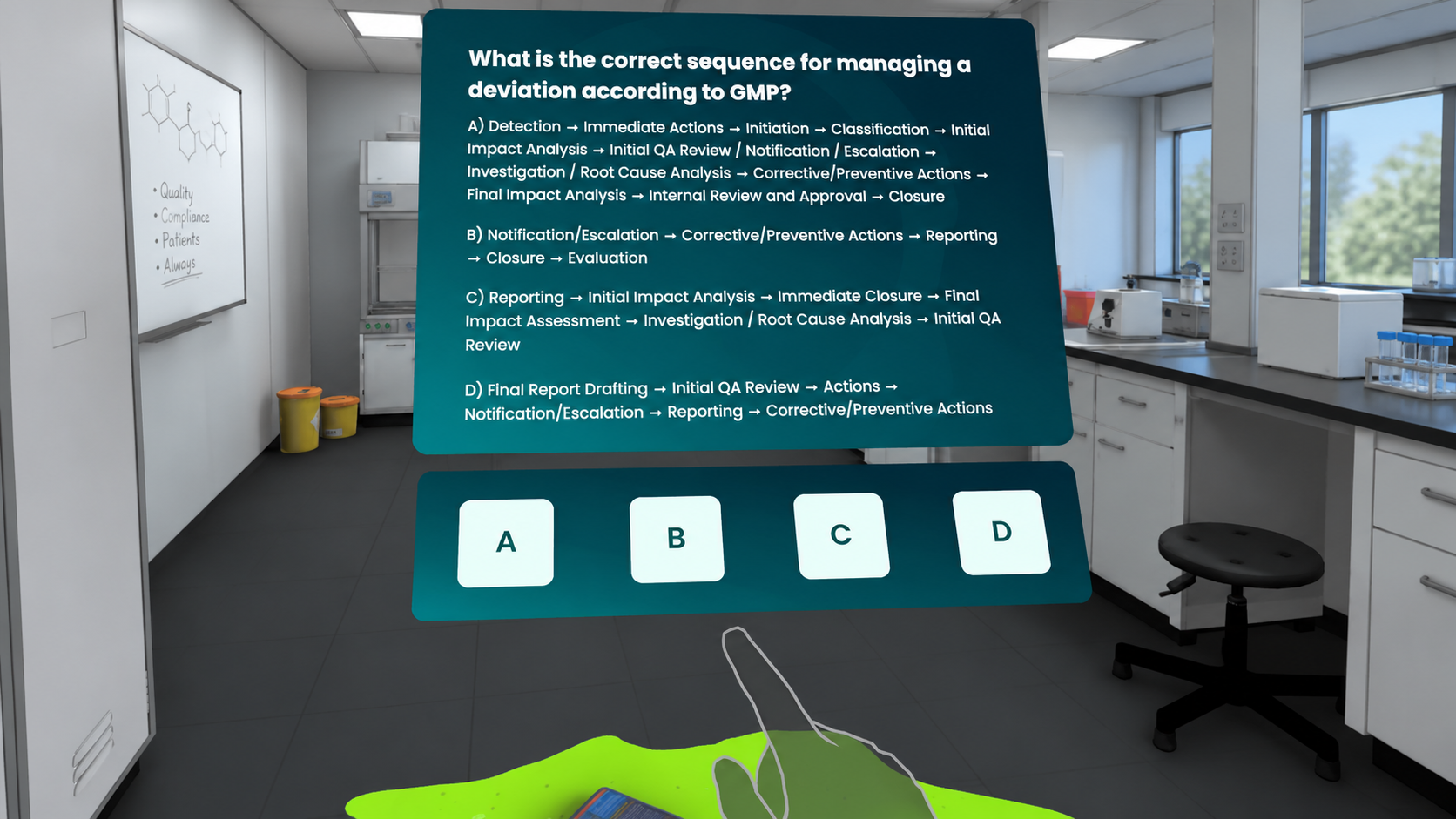
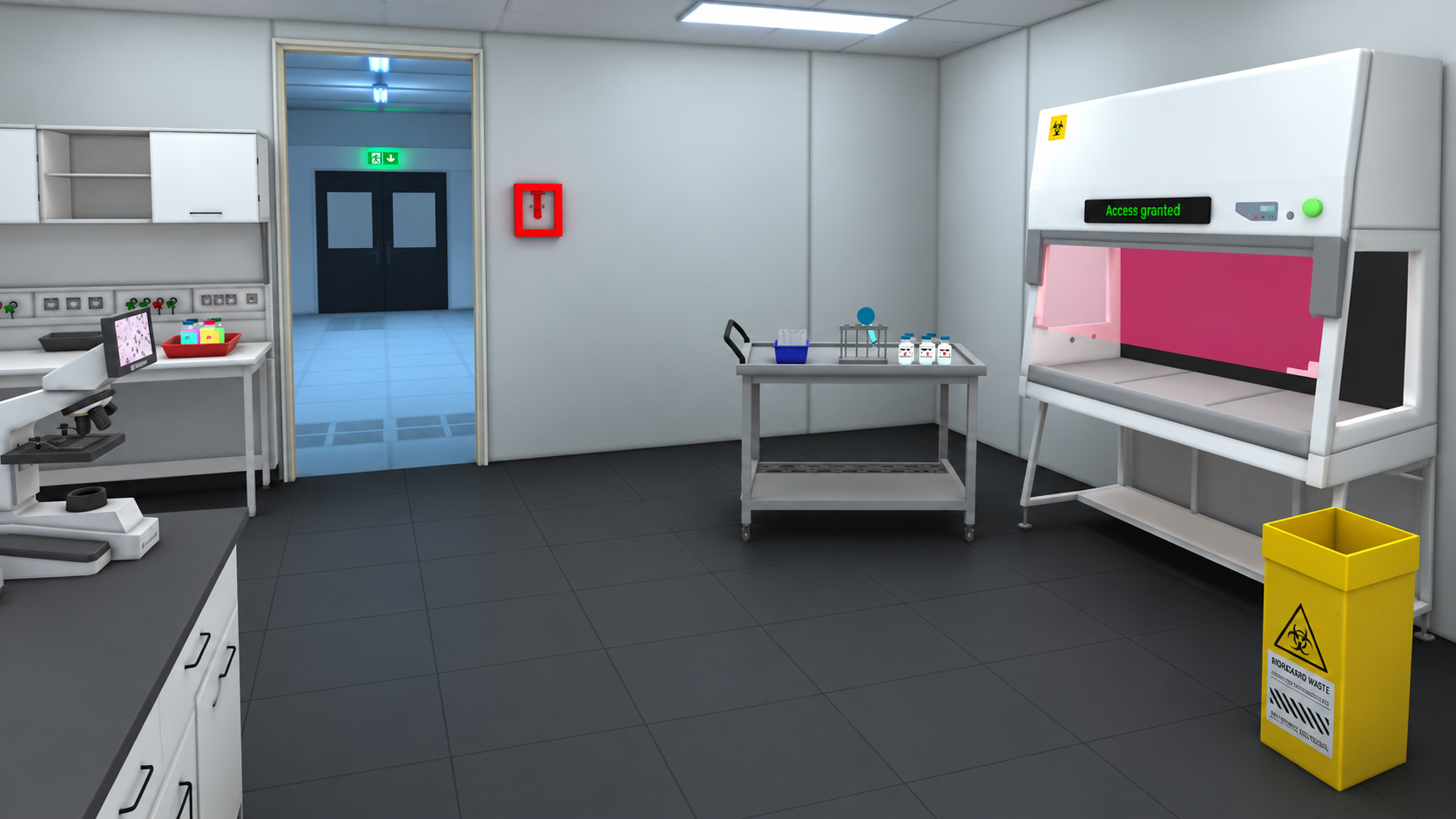
That’s the insight behind Escape Lab. We placed users in a realistic laboratory emergency: toxic gases have been dispersed. They must safely retrieve a development solution and evacuate, but only while adhering to strict safety protocols and Good Manufacturing Practice (GMP) compliance.
The escape room narrative wasn’t just for fun. Emotional engagement is proven to enhance memory encoding. When your brain processes something with emotional weight, whether fear, urgency, or achievement, it remembers it far better than passive information delivery.
The experience unfolds through eight sequential stages:
- Security validation — badging and access codes
- Pressure equilibration — navigating Safety Access Stations (SAS) before entering different zones
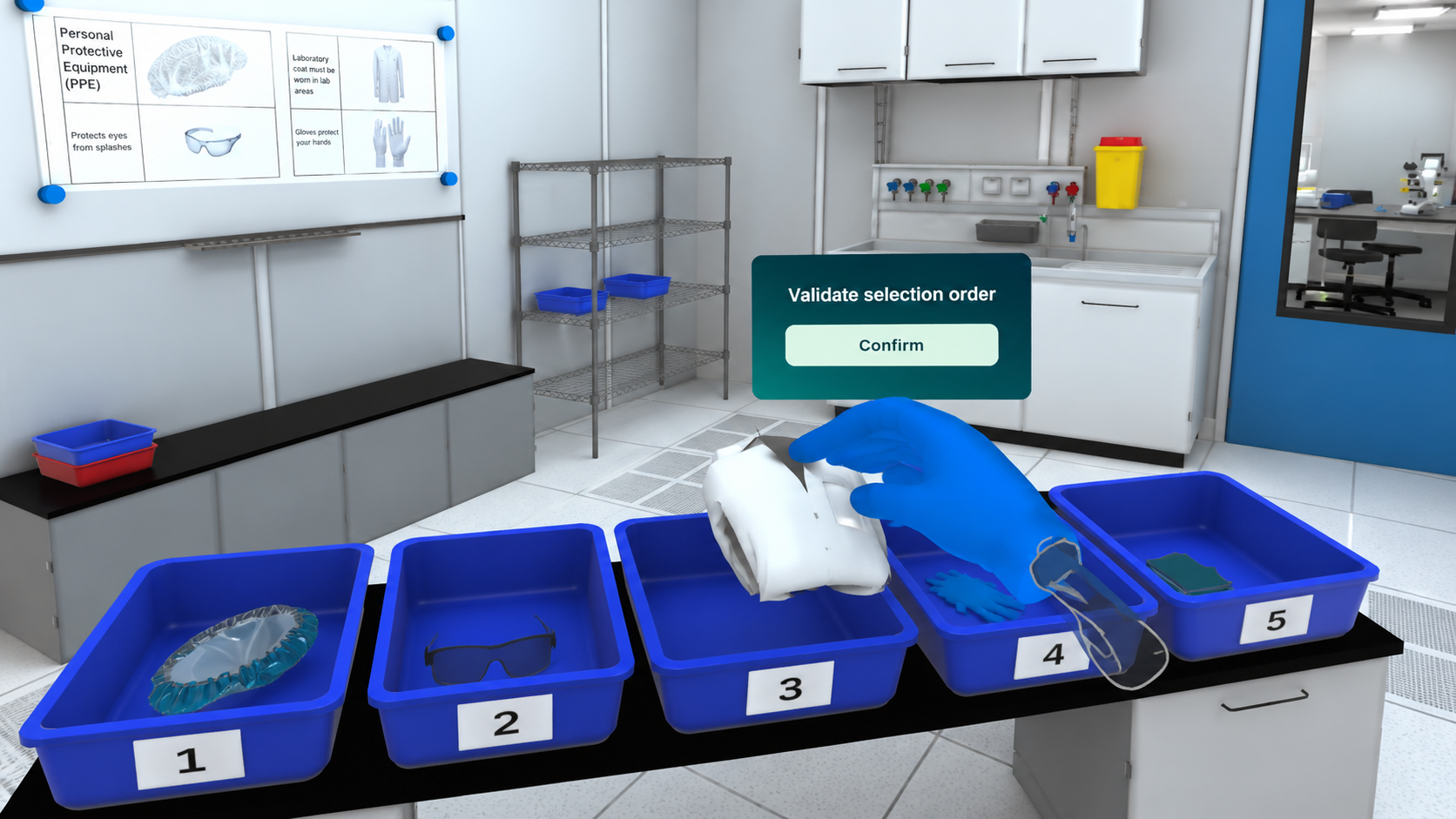
- Equipment preparation — precise, regulated sequence (shoe covers, head covering, gloves, protective vest)
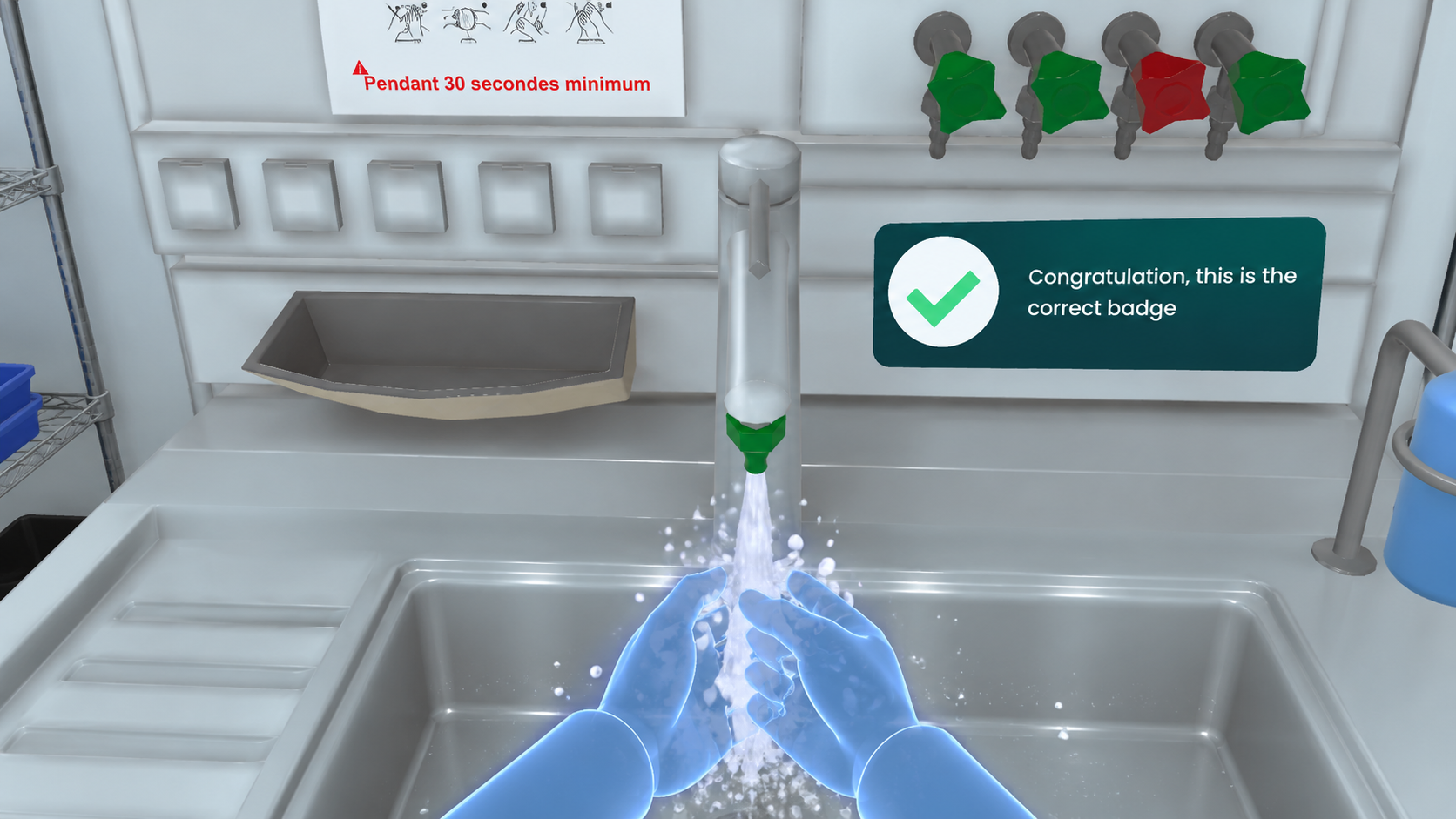
- Hand-washing procedures — exact timing and positioning requirements
- Laboratory navigation — with embedded technical questions
- Computer access — authentication with integrated knowledge checks
- Solution recovery — retrieving the development solution
- Safe evacuation — maintaining safety protocols throughout
Throughout, users collaborate with team members outside the headset who access a shared information document. When the user in VR needs help, “I’m at SAS One, what information do I need?”, the external team members search the documentation and communicate the answer. Everyone learns simultaneously. Everyone sees mistakes happen and discusses them together.
This collaborative model was deliberate. Rather than requiring five VR headsets for five trainees, one person experiences the immersive environment while colleagues outside contribute to shared objectives. It reduced hardware costs, enabled peer learning, and developed soft skills like clear communication under pressure, something that happens naturally in an escape room dynamic.
The technical choice: Hand-tracking over controllers
From previous experiences, we had learned that controllers tend to create friction that undermined learning. (Read our articles on how we leveraged Mixed Reality for bike repair and how we made the invisible visible with our biological safety cabinet.)
Why:
Users familiar with gaming naturally positioned their hands correctly. They knew which button was which. But everyone else struggled. The facilitator had to physically reposition each person’s hands, uncomfortable and creating unnecessary cognitive load.
Worse, users spent their first ten minutes learning button mappings instead of focusing on the actual training objective. When they made mistakes with inputs, frustration killed engagement and undermined learning.
For Escape Lab, we applied that knowledge from day one: no controllers.
Natural hand gestures proved far superior. No tutorials needed. No awkward positioning. Users could focus entirely on mastering safety procedures.
Yes, we couldn’t provide full haptic feedback, users don’t feel water on their hands during hand-washing sequences. But the physical gesture performance itself created something powerful: the beginning of muscle memory.
Think about how you drive a car. You don’t consciously think about clutching or shifting gears anymore. It’s become a reflex. The same principle applies in a pharmaceutical laboratory. The earlier you establish those physical patterns, the faster learning happens. By performing the hand-washing sequence, the equipment donning procedure, and the safety protocols with their actual hands, even without full haptic feedback, users were building muscle memory through embodied learning.
Escape Lab validated what we’d already discovered: natural gesture-based interaction isn’t just better for user experience. It’s essential for learning-focused applications.
What testing revealed
We deployed Escape Lab in a real pharmaceutical laboratory with actual clients. The feedback was overwhelmingly positive.
Facilitators reported something striking: sustained engagement throughout two-hour sessions. This contrasted sharply with traditional training, where attention typically wanes after 30-40 minutes. Users maintained focus. They stayed immersed. They wanted to succeed.
The experience also revealed communication patterns within teams. Facilitators could see who shared information clearly and who struggled with information transfer, insights that extended beyond the VR experience itself.
But testing also revealed two critical gaps:
First, insufficient knowledge checks. Users could progress through the experience without encountering enough technical questions to reinforce learning. The team added quiz questions at strategic points, when accessing the computer, when navigating different zones, embedding them naturally into the narrative flow rather than presenting them as interruptions.
Second, inadequate feedback. Initially, users received just a simple yes/no result panel at the end. The team discovered that collaborative discussion of performance was essential for learning. The solution was elegant: transition to mixed reality at the end, displaying detailed result panels that the entire team could review together, discussing what went well and what needed improvement.
These weren’t afterthoughts. They emerged from direct user feedback and shaped the final product.
Impact: Five enterprise deployments and beyond
Escape Lab was deployed with five enterprise clients on their VR headsets. The results spoke for themselves.
Facilitators reported reduced time required for hands-on laboratory supervision, accelerating the path to independent work. Users maintained engagement throughout full sessions. Teams communicated more effectively. Learning outcomes improved.
We learned that the most powerful learning experiences aren’t the most technologically complex. They’re the ones that respect users’ cognitive load, leverage emotional engagement, and create space for reflection and collaboration.
How we’d build it today
If we approached the same challenge in 2026, we’d make different choices.
We’d track performance data more granularly, adapting difficulty dynamically based on user progress. We might use AI to provide real-time coaching or personalized feedback. We could explore multi-user VR where multiple trainees experience the scenario simultaneously.
But here’s what we wouldn’t change: the collaborative external-team model proved so effective that the trade-offs of multi-user VR would need careful consideration. Sometimes the most elegant solution isn’t the most technologically advanced.

Julie Morand
Senior Unity Developer